It
has taken me six months to cool down sufficiently to do this post. And I
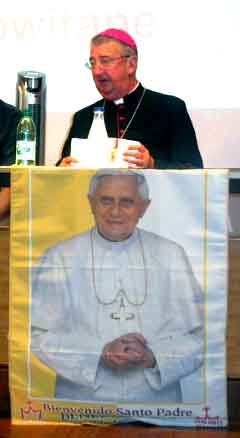
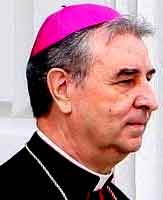
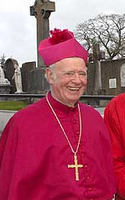
almost lost it again when I saw the remarks of Bishop Dermot Clifford
of Cashel and Emly in last Monday's
Irish Times (18/8/08).
The
gist of the story is that certain Roman Catholic Bishops in Ireland
have been systematically denying people direct access to parish records
of baptisms and marriages despite these records being included in the
microfilm collection in the National Library of Ireland.
To be
fair, most Bishops have given direct access to their original records,
both through the National Library and in parish offices. This allows
direct consultation of the records even where they have not been filmed.
Most parish offices are very cooperative in this regard.
There
are, however, three bishops listed as limiting access to the filmed
originals in the National Library and Clifford was the most obdurate of
these. To get access it was necessary to get clearance from the relevant
palace. Clifford's palace informed callers that the bishop
never gave permission for direct access and that it was always necessary to approach them through the diocesan heritage office.
This office operates on computerised versions of the originals and charges a whack for what is in effect pushing a button.
I
do not object to people providing a service and charging for it. It is a
very useful facility for those who are not in a position to consult the
originals or who are happy to have the records pre-sorted for them. My
objection is to the bishop denying parallel access to the original
records. As every researcher knows, there are always transcription
errors in populating databases. So there is no substitute for consulting
the original. Also new lines of search can suggest themselves from
details spotted on the originals (eg sponsors, locations, name
variations etc.).
Clifford has put forward a grandiose justification of his stance on the
diocesan/heritage site.

We
are told that these records are not public records and that the
information in them has been entrusted to the church by the subjects
concerned.
Am I hallucinating when I seem to recall clergy
reading people off the altar for inadequate contributions to various
collections.
No question of confidentiality here when the financial implications were in the opposite direction.
And
these same people would already have been charged a whack by the church
for access to the sacraments, the records of which are now yielding a
further flow of income in perpetuity. I'm not sure whether this would
best be described as a cash cow or a golden goose. A golden calf more
likely.
I am also old enough to remember the original
introduction of "planned giving" in the Dublin diocese when the church
attempted to have its cake and eat it by "pawning" church furniture,
from the high altar to the cruets, to top up its coffers.
It is
interesting that the bishop has quoted the judgement of Diarmaid against
St. Colmcille in the case of the copying of the bible. Some of St.
Colmcille's arguments are extremely relevant today and in reading up the
case I was struck by the extent of the
uisce faoi thalamh involved. Nothing, it appears, is as it seems.
The
National Library has now opened access to these filmed originals in the
face of objections from the bishops concerned. It has taken a stand
which is in the interest of the people of Ireland and against the mean
money grubbing stance of a small minority of the RC hierarchy.
These
registers are clearly quasi-public records. This emerges quite clearly
if they are set in the context of their day and of the dominant position
of the church over its flock.
Indeed,
the roles of church and state were so entwined that the church insisted
that its marriage ceremony served also as a civil one and the parish
simply notified the state that the marriage had taken place. No only
that, but the reading or posting of the banns in church was accepted by
the state authorities in place of the usual notices in the national
press required in the case of purely "registry office" marriages.
And as far as letters of freedom were concerned, these simply proved you had not already been married
in a church
and that a church wedding could take place. However, I'll bet many of
these ceremonies were notified as civil marriages without regard to
whether any civil ceremony had already taken place.
Until fairly
recently, church marriage certificates were accepted as evidence of
civil married status by the authorities (eg for state or occupational
pension schemes).
Some
priests carried this symbiosis to the point of "near-perjury". I know
of a case (in 1950) where a couple got married in a Protestant church.
The vicar duly notified the civil authorities and the marriage was
registered by the state. Six months later, and probably due to
ecclesiastical and/or family pressure, the couple married again, this
time in a Catholic church. The priest duly notified the state which
recorded the new marriage. In the second case, the bride and groom are
described as spinster and bachelor respectively, which, respectfully,
they were not, at least in the eyes of the state.
So this church
(sorry, a few members of its hierarchy, in this particular case) is
claiming to be a private institution, and this in relation to periods
when they were anything but. (We can save the discussion on education
and property and salaries for another day, or go check out Bock below.)
While
I'm at it, the originals of some of the parish registers around the
country are so badly kept that, had they been acknowledged as public
records, those who kept them should have stood trial for malicious
damage to public property. Some of the ledger pages look like the parish
priest had regularly eaten his lunch off them.
I don't know the
content of the legal advice that has given the National Library the
confidence to do what they have done. All I can say is I hope they hold
their nerve and, if the church wants to go to court, may they get the
judgement of Colmcille over that of the pagan MacDe.
I was going to title this post "
God Bless the National Library", and would have meant it, but I couldn't resist the temptation of the insult I eventually settled on.
If you still have steam coming out your ears you might enjoy some further ruminations at
Brother Bock's Asylum for Refugees from the Pulpit.
AddendumI really can't decide whether to laugh, or cry, or just keep banging my head off the nearest stone wall.
It
has been drawn to my attention that the Bishops' latest excuse for
whatever restrictions they are putting on access to parish records is to
avoid the posthumous conversion of the dead to Mormonism.
The
Vatican
has apparently put the Bishops on notice that their deceased flock are
not to be hijacked in this manner and the only way to avoid this is to
make sure that parish records (from whatever era) do no fall into the
hands of these evil evangelising Mormons.
What a load of theological crap and self serving rubbish.
My
initial reaction to this Bishop's defence (as my chess friends might
describe it) was that any bishop that believed this heretical rubbish
should be immediately sacked by the Vatican. Imagine my horror to find
that it was actually the Vatican itself that was circulating this
nonsense.
If the Roman Catholic Church believes, which it appears
to, that the Mormons can posthumously hijack its flock in this way, it
should just fold up its tent and go home. This is ceding theological
supremacy to the Mormons, in whose church there should not, strictly
speaking, be even salvation.
How low will the RC church stoop to protect its income stream?
That we could bring back Jesus Christ himself and eject these traders from the Temple.
This
article
in the Irish Times of 28/8/08 sets out the background. I agree
wholeheartedly with every word written by its author, as you will have
gathered by this stage.
Labels: access, crap, dermot clifford, genealogy, greed, mormons, national library of Ireland, parish registers, posthumous conversion, roman catholic church
 bulls
bulls  I can now reveal the third secret of Fatima and also why it has not been properly published up to now.