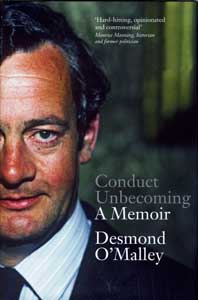
Conduct Unbecoming - A Memoir
Desmond O'Malley
Dessie on his time at EBRD
The experience was fascinating. We lived in an apartment at Finsbury Square, near the financial district. I was able to walk to work every day. It was a good quality of life.
The position of director was for a three-year term. I was at first somewhat uncertain before I arrived in London, because I had no banking experience. But the ebrd is not like a normal bank: its task is to fund projects in post-Soviet states in central and eastern Europe and in parts of central Asia. The beneficiary countries include the likes of Poland, Belarus, Azerbaijan, Kyrgyzstan and Uzbekistan. The theory was that they would require help in building properly functioning market economies. Indeed it was the specific remit of the bank to assist the transition to democracy and market economies.
The ambition looks rather naive now, with the benefit of hindsight, for few of the non-European countries are any kind of an advertisement for the goals originally stated. In fairness, I have to say that they were generous goals, even if the subsequent experience has proved disappointing.
The role of director involved assessing investment projects proposed by the ebrd's staff. The bank provided financing for infrastructure and other projects that assisted in private-sector development. Investments ranged in value from ¤5 million to ¤250 million. I travelled quite a bit to countries in the Balkans and in the Baltic region. I saw the job of director as asking questions of the executive staff. Some of them didn't like being queried, but I was thanked for my role when my term came to an end.
In theory, the Irish-nominated director of the ebrd reports to the Department of Finance. But I was mostly left to make decisions in accordance with my own judgement. A lot of the issues have nothing to do with Ireland, which is not a major contributor because of each member-state's contribution level having been set in 1991. Directors from other countries were not so fortunate: they would frequently get calls from their home governments with instructions on what to do about certain projects.
As an international institution backed by such countries as the United States, Germany, France and Britain, the ebrd had a very positive reputation, and people were obviously keen to be supported by it. One Russian oligarch applied for investment support for a project worth several hundred million euros. I reviewed the paperwork and, having done a little research, saw that this man's net personal worth, accumulated in the period after the collapse of the Soviet Union, was actually far greater than the ebrd's assets. 'We shouldn't really be lending this guy money,' I said to my colleagues: 'he's only using us to buy a good reputation for himself.' I could see he wanted to have ebrd on his company's cv. My colleagues knew I was right, but many of them couldn't say so. Their countries couldn't afford to fall out with Russia, where this oligarch was very well connected. He didn't get funding in my time, although I think he did get something later.
One of the biggest projects under discussion in my time with the ebrd was a 1,750-kilometre pipeline to take crude oil from the Caspian Sea to the Mediterranean. Investment in the Baku-Tbilisi-Ceyhan (etc) pipeline was put at $3.6 billion. The oil was in the Azeri section of the Caspian Sea. We also invested in oil extraction facilities at Sakhalin Island, a large Pacific island in eastern Russia. This was the only known breeding-ground for the western grey whale, and for a time the ebrd directors, including myself, became experts on this animal as pressure was placed on Shell and other exploration companies to ensure its preservation.
I quickly discovered that bankers loved property; they saw it was an easy way to make money. The returns were good. But I expressed concern at proposals to invest in luxury houses of 7,000 square feet in Russia. There was a stalemate on the issue.
The most frequent references to Ireland during my term were when officials and ministers from countries in central and eastern Europe would approach me about Ryanair. There was huge interest in getting Ryanair to fly into their countries, and they all wanted to know if I could put them in touch with Michael O'Leary. Against this background it was therefore personally gratifying when I was in London at the ebrd, remembering the battles of the 19805, to hear the enthusiastic response to the Ryanair success from right across Europe.
pps 230-2