Na hUaisle was formed as a group in 1970 by Aodh Ó Domhnaill and Nóra Ní Dhomhnaill, who had been singing together for some time. Generally, Aodh wrote the lyrics and basic melodies for the songs while Nóra provided the arrangements — voice harmonies and instrumentalisation. Dominic Ó Longáin was originally the third member of the group.
One of the group's earliest successes was winning the newly instituted Oireachtas competition for group with guitar. This category was a serious departure for the Oireachtas from its more traditional competitions and it indicated their willingness to keep up with the times and adopt a more inclusive attitude to the evolving culture in the Irish language.
The name "Na hUaisle" was meant ironically — a dig at "the Gentry" who in earlier days in Ireland would have been Anglo-Irish and non-Irish-speakers.
The songs were either satirical or protest songs and, while exclusively in the Irish language, they dealt with community and social issues in a much wider context than the language revival. It was a conscious choice by the group to confine themselves to expression through Irish even though that limited their audience.
They were influenced by the emerging protest movement of the 1960s which emphasised civil rights and the environment, but they were also sensitive to the particular Irish issues of the day - foremost among which were the Irish language, the pre-eminence of the Roman Catholic Church in Irish society, the evolving nature of national sovereignty and community issues in general.
At the time, the group was the only protest group singing in the Irish language, and the pity is that their songs were not available to a wider audience given their relevance to the issues of the day.
The initial gigs
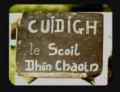 One of their earliest, and most successful, gigs was a performance in Liberty Hall, Dublin, at a concert organised to protest the closure of the local primary school in Dún Chaoin in the Corcha Dhuibhne Gaeltacht in West Kerry. There was a general movement at the time to close one and two-teacher schools in the name of economy and supposed wider subject choice for pupils. However, the effects on local communities could be devastating, the more so when linguistic issues were involved. Initially, there was little regard for the effects of this policy on the viability of the dwindling Irish-language communities throughout the country and protest crystallised on resistance to the closure of the Dún Chaoin school.
The atmosphere in Liberty Hall was electric and the group brought the vast crowd to its feet with their rendering of the newly-composed song "Dún mé". While Its melody was from Roger Miller's popular hit "Dang me", the words and sentiments were exclusively Irish and pilloried the then Government for its hypocritical attitude.
The group also sang at numerous and varied functions — including a political party dinner and an Interskola Annual Meeting, concerts in the Damer and various events around the courtry. The party dinner was for Fianna Fáil, of the the two major parties the one appropriating the republican tradition's so-called revival of the Irish language. The party faithful conversed non-stop during the performance, and since ha hUaisle's songs depended largely on the satirical lyrics, missed the point of all the songs.
Radio and TV appearances
Wider national recognition was not far away, however, and after numerous one-off TV and radio appearances the group was offered a resident spot on the RTÉ television series ÓRÓ. They wrote, rehearsed and performed a new song (with a live audience) each week for six successive weeks. The subject matter ranged across a wide range of issues and the songs were being written and rehearsed on the fly. The show was produced by Liam Ó Murchu, then head of Irish programmes for television, and directed by Seán Cotter.
Other individual TV gigs, including a Christmas Special, followed over the years until the group finally dissolved into the demanding area of child rearing.
Dún mé: This was one of the group's most successful songs and the one which electrified the audience at the Liberty Hall concert referred to above. The title means "Close me" and songs retails the saga of the Dún Chaoin primary school in the context of the closure of small local primary schools and the implications for linguistic communities.
EEC: Ireland joined the EEC, as it then was, in 1973, following a national referendum. This song became one of the anthems of the anti-EEC campaigners and it sets out in some detail the implications for Ireland of future globalisation.
Teanga na nGael: This song is set in the future and wonders if anyone remembers the "old Irish tongue" on which much hypocritical effort was expended after the foundation of the State. It contains one of the most onomatopaeic lines in the Irish language.
Iolar Rua and 1984: were songs about pollution, drawing respectively on the ancient Fianna mythology and the smog and dirt of urban living.
Ar Mhullach Bhinn Eadair and Dá mbéinnse leatsa: were love songs.